Keep a Rotary Phone Alive on LTE: Build a Reversible ESP32-S3 Bridge You Can Own
A reversible ESP32-S3 and LTE bridge can turn an old rotary phone into a personal cellular gadget you own, not rent.
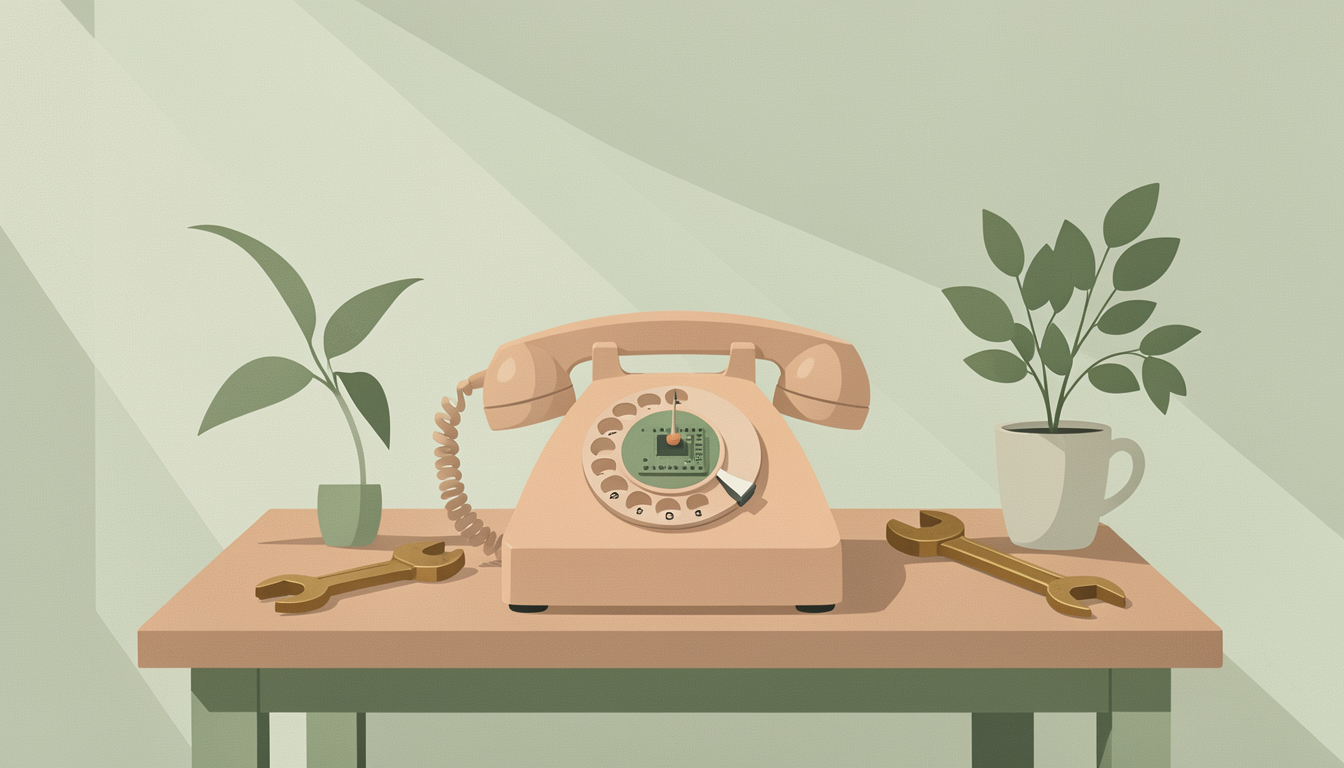
The case for owning a small signal
A rotary phone is a physical object: a dial, a handset, a ringer, and a switch-hook. The core move is to convert a traditional rotary telephone into a battery-powered portable cellular telephone without modifying the original telephone.
The added electronics mount reversibly inside the case, and no original telephone parts need to be drilled, cut, or permanently altered.
The phone does not ask for a login, a renewal, or a permission update. It sits on a desk, takes a call, and lets you hang up. For a one-person company, that kind of calm is not nostalgia. It is margin.
A rotary phone is an odd candidate for modern life. It has no app, no cloud dashboard, and no habit of asking what you are doing with your attention. Yet it has a durable interface: a dial, a handset, a ringer, and a switch-hook. Those parts are simple enough to understand, and simple enough to keep.
The goal is not to make a museum piece. The goal is to build a personal hardware path that can carry a voice call over a cellular network while leaving the original object intact. If the project works, you own the signal. If it does not, you can remove the added electronics and return the phone to its former life.
What the bridge actually does
The durable trick is to keep the controller and radio side on one board. The controller and radio side can be handled with the LilyGO T-A7670G-S3 Standard board, which supplies the ESP32-S3 controller, A7670 cellular modem, battery charging, and cellular audio interface. The Silvertel AG1171 subscriber-line interface operates the telephone line circuitry, senses the switch-hook, and drives the mechanical ringer. With those pieces together, the prototype supports rotary pulse dialing, switch-hook detection, and incoming and outgoing cellular calls.
Treat the project as a working engineering archive rather than a finished construction release, with the hand-wired prototype operating while PCBs await validation.
That is enough to make the object useful. It is not a smartphone, and it should not be sold as one. It is a narrow tool: a handset that can ring, dial, and talk through a cellular connection while preserving the mechanical character of the original phone.
A calm build path
Before you buy parts, write down the rules. They are the difference between a project and a possession. The best way to keep the project small is to treat it as a sequence of reversible decisions. Each step should be testable on its own, and each step should be undoable without a rescue kit. Start with reversible hardware: choose a phone that is already clean, stable, and emotionally acceptable to experiment on, and use fasteners, sockets, and connectors that can be undone so the phone remains a phone when the electronics are gone. If the bridge cannot be removed without damaging the object, it is not a bridge; it is a modification. Count the hours before the parts; a project that costs an afternoon is different from one that becomes a weekend tax, and if the build cannot be finished in a bounded session, shrink it. Keep the logic in one place, with one controller visible during the early build, because a single controller is easier to debug, easier to replace, and easier to understand when it fails. Once the path is stable, you can decide whether to make it neater. Keep one modem, and do not scatter radio functions across boards, because one cellular path is enough for a voice gadget and complexity is a subscription you pay in attention. Keep the build free of cloud dependency: the device should work without a dashboard, a remote service, or a second account, and if a call requires a cloud relay, ask whether you are building a gadget or renting a dependency. Define the call path first, with a voice call, a ringer, and a dial, and resist the urge to add data, cameras, or remote monitoring. Test the telephone side separately so the dial, hook, and ringer behave before the cellular side carries a conversation. When the build is finished, write down the hours you spent, not just the cost, because a one-person company lives on attention and a gadget that quietly consumes evenings is a bad employee. These rules are not romantic. They are maintenance. A small communication gadget is only ownable if you can explain it, repair it, and remove it without leaving a scar.